
Postsecondary Readiness in our Region: Class of 2025
Ensuring high school graduates are ready for their next steps, whether that’s college, career training, or direct employment, is critical to preparing the future workforce. Within the Commonwealth of Kentucky, public high schools are graded on their graduates' postsecondary readiness. These standards assess students' preparedness to transition to the next level of their education or career path. Formerly known as “college and/or career ready,” postsecondary readiness is an important accountability measure used by the state to ensure high schools are preparing students for a successful economic future. This article examines how school districts and high schools in the KentuckianaWorks 7-county service region performed in school year 2024-2025.
Defining Postsecondary Readiness
Kentucky state law currently defines postsecondary readiness as high school graduates who achieve one or more of the following:
1. College admissions test score
Meeting or exceeding a college readiness benchmark score on the college admissions examination or a college placement examination approved by the Council on Postsecondary Education
2. Dual credit
Achieving a minimum of three (3) hours of dual credit by completing a course approved by the Kentucky Board of Education or qualifying for a minimum of three (3) hours of postsecondary articulated credit associated with a statewide articulation agreement
3. Advanced Placement (AP) test score
Achieving a benchmark score on an Advanced Placement, International Baccalaureate, Cambridge Advanced International, or other nationally recognized exam approved by the Kentucky Board of Education that generally qualifies the student for three (3) or more hours of college credit
4. Work experience
Completing a required number of hours or achieving a benchmark within an apprenticeship, cooperative (co-op), or internship that is aligned with a credential or associate degree and approved by the Kentucky Board of Education after receiving input from the Local Superintendents Advisory Council
5. Industry certification
Achieving any industry-recognized certifications, licensures, or credentials, with more weight in accountability for industry-recognized certifications, licensures or credentials identified as high demand (referred to as the “high demand bonus”)
Postsecondary Readiness Among the Class of 2025
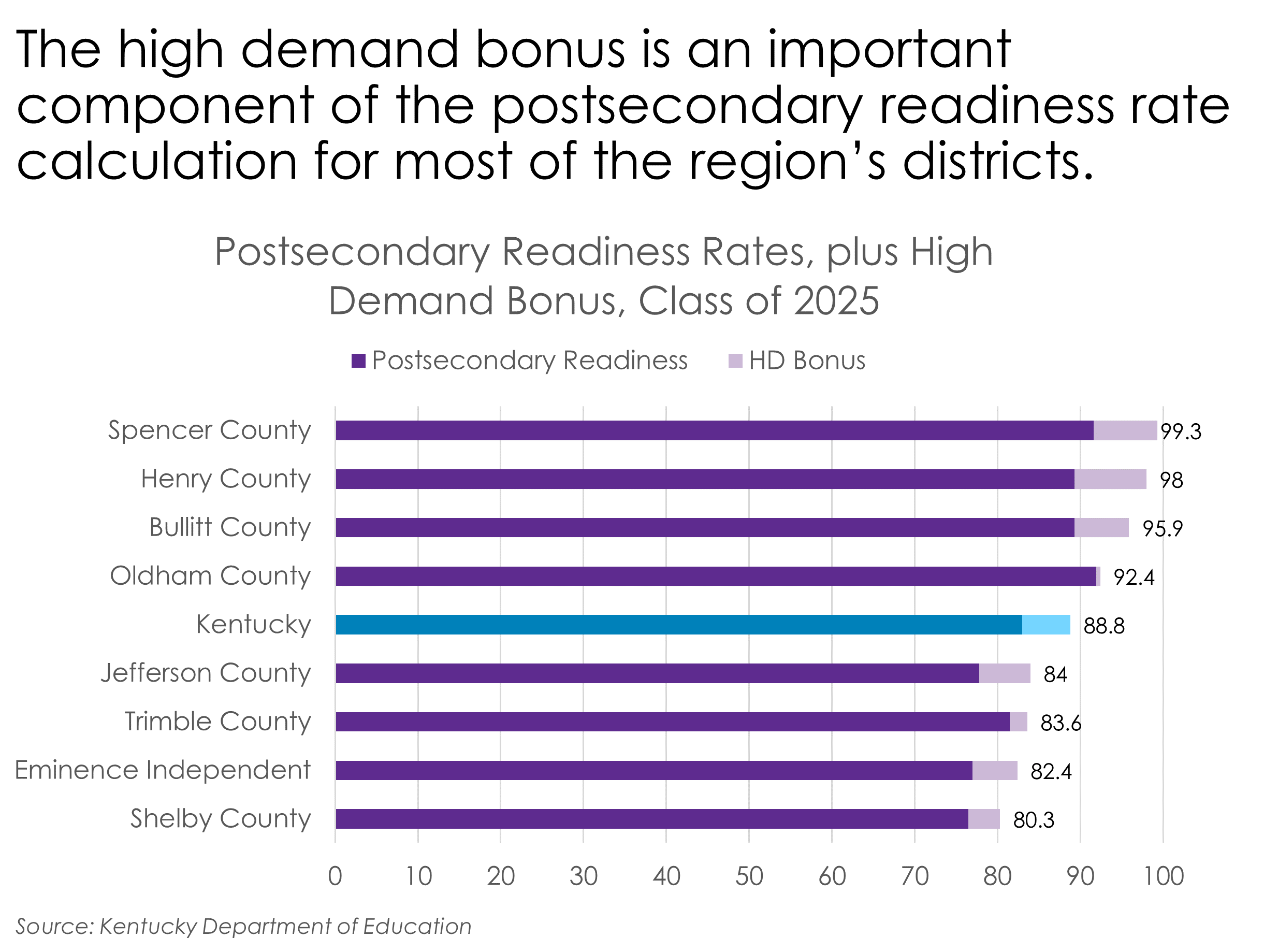
Among the graduates of the class of 2025 in public schools across the Commonwealth, 83% were considered postsecondary ready. With the bonus points accrued through the achievement of high demand industry certifications, the postsecondary readiness rate for the class of 2025 was 88.8 percent.
Postsecondary readiness rates varied among the school districts in the KentuckianaWorks 7-county service region. In Shelby County Public Schools, 76.5% of graduates were considered postsecondary ready. Meanwhile in Oldham County Public Schools, 91.9% of graduates met this mark. However adding in the high demand bonus changes the distribution, now ranging from 80.3% in Shelby County to 99.3% in Spencer County. The high demand bonus is an important component of the calculation for most of the region’s districts, indicating the importance of industry-recognized certifications in high demand fields to the postsecondary readiness determination. It added 8.7 points to Henry County’s postsecondary readiness rate, and 7.7 to Spencer County’s. On the other hand, the bonus only accounted for an additional 0.5 point in Oldham County, suggesting less reliance on industry-certifications as the way students are designated postsecondary ready. The remainder of the article will report postsecondary readiness rates with the high demand bonus, since they are an important component of the state’s Accountability system.
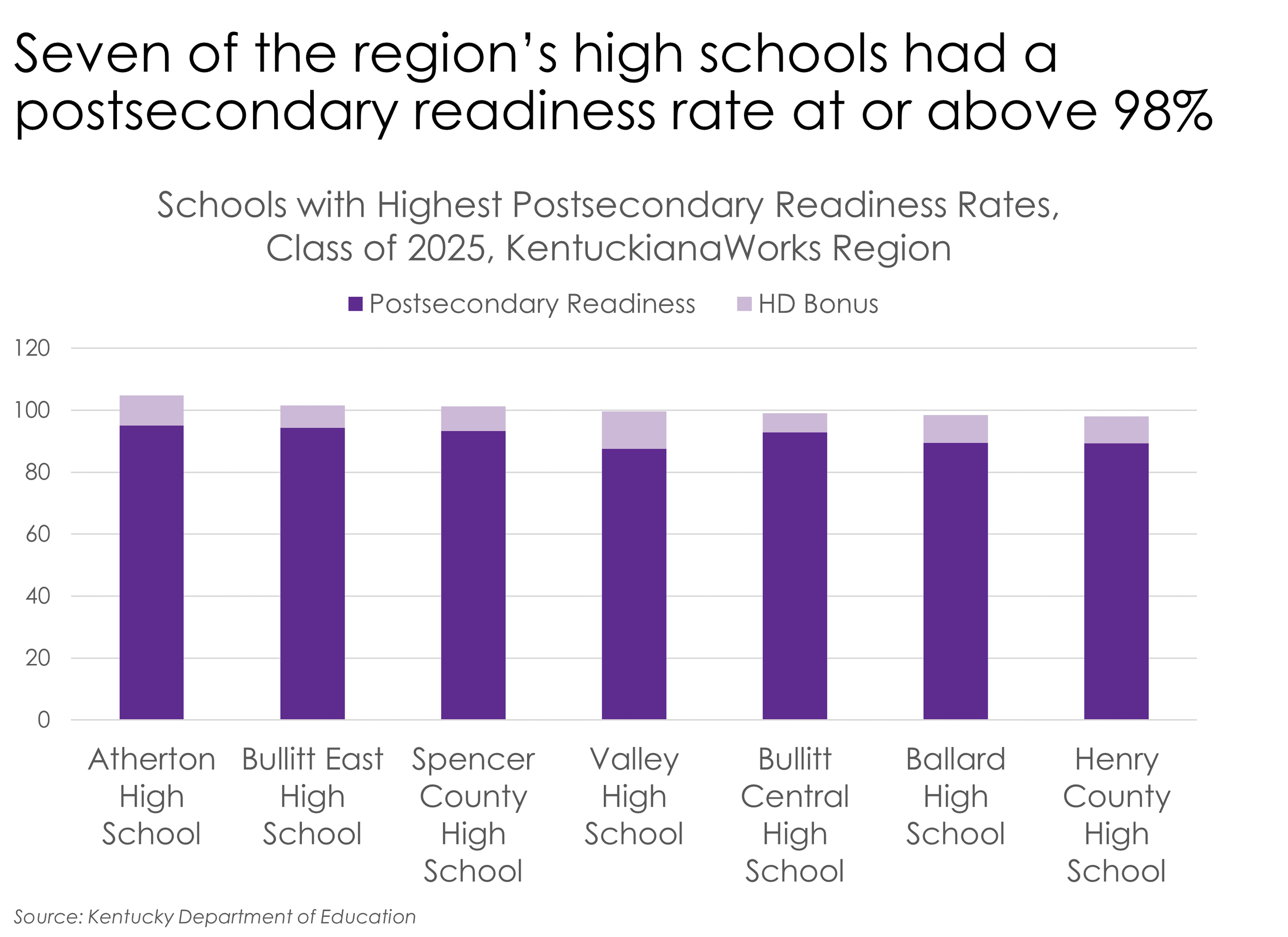
Among individual high schools in the KentuckianaWorks 7-county service region, postsecondary readiness rates with the bonus ranged from 104.8% at Atherton High School in Jefferson County, to 44.7% at The Academy @ Shawnee in Jefferson County. (Students earning high demand certificates accrue 1.25 points for their schools, instead of just one point, so a school’s rate can exceed 100 percent.) Eighteen of the region’s high schools had a postsecondary readiness rate of 90% or higher, and seven of those were at or above 98%.
Comparison to Last Year
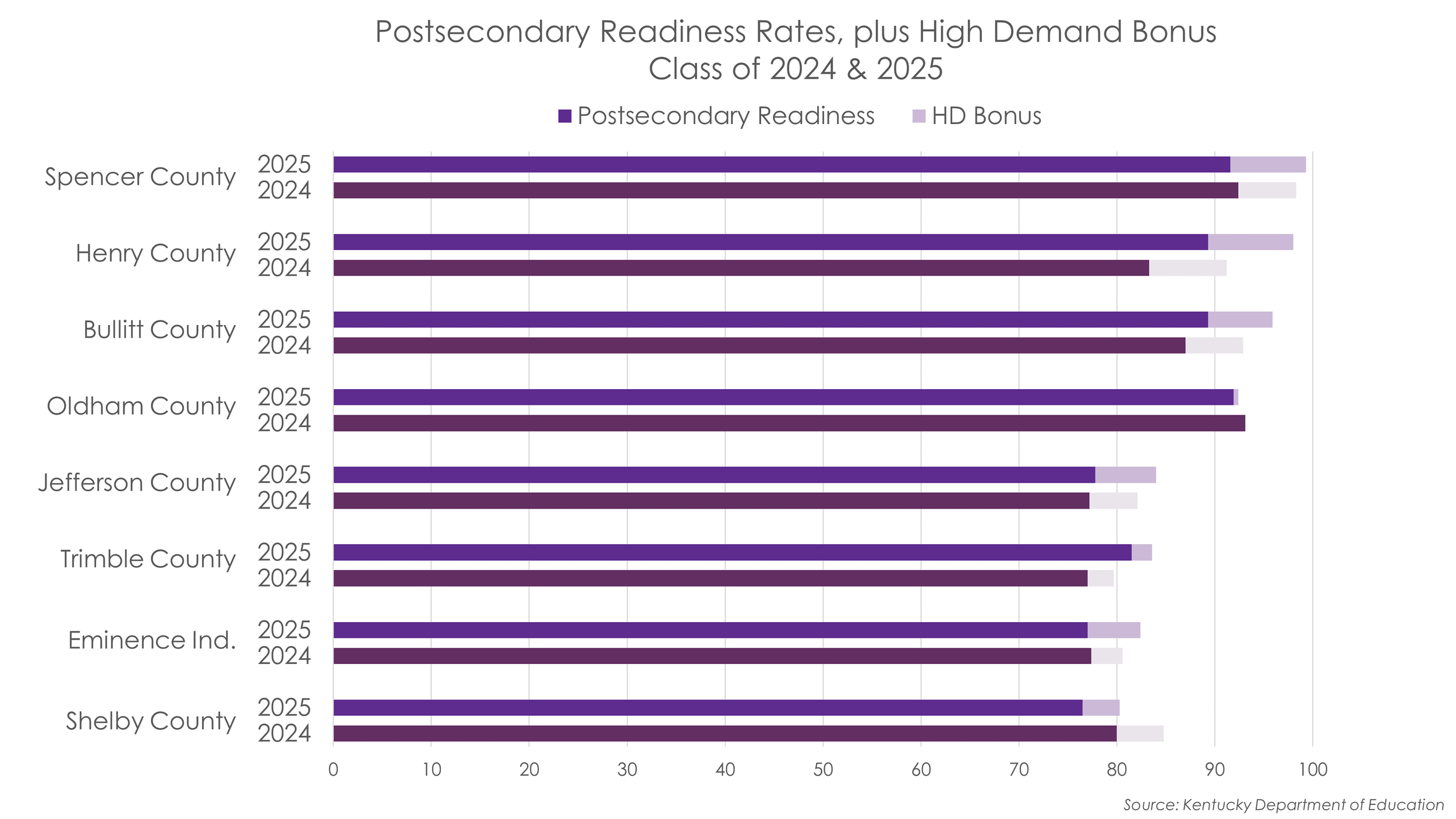
Most of the school districts in the KentuckianaWorks 7-county service region saw an improvement in their postsecondary readiness rates between 2024 and 2025. Henry County and Trimble County had the largest increase in postsecondary readiness over the year. Jefferson County, the region’s largest school district, improved to 84%, up from 82.1% the year prior. Meanwhile, postsecondary readiness rates declined over the year in Shelby County and Oldham County.
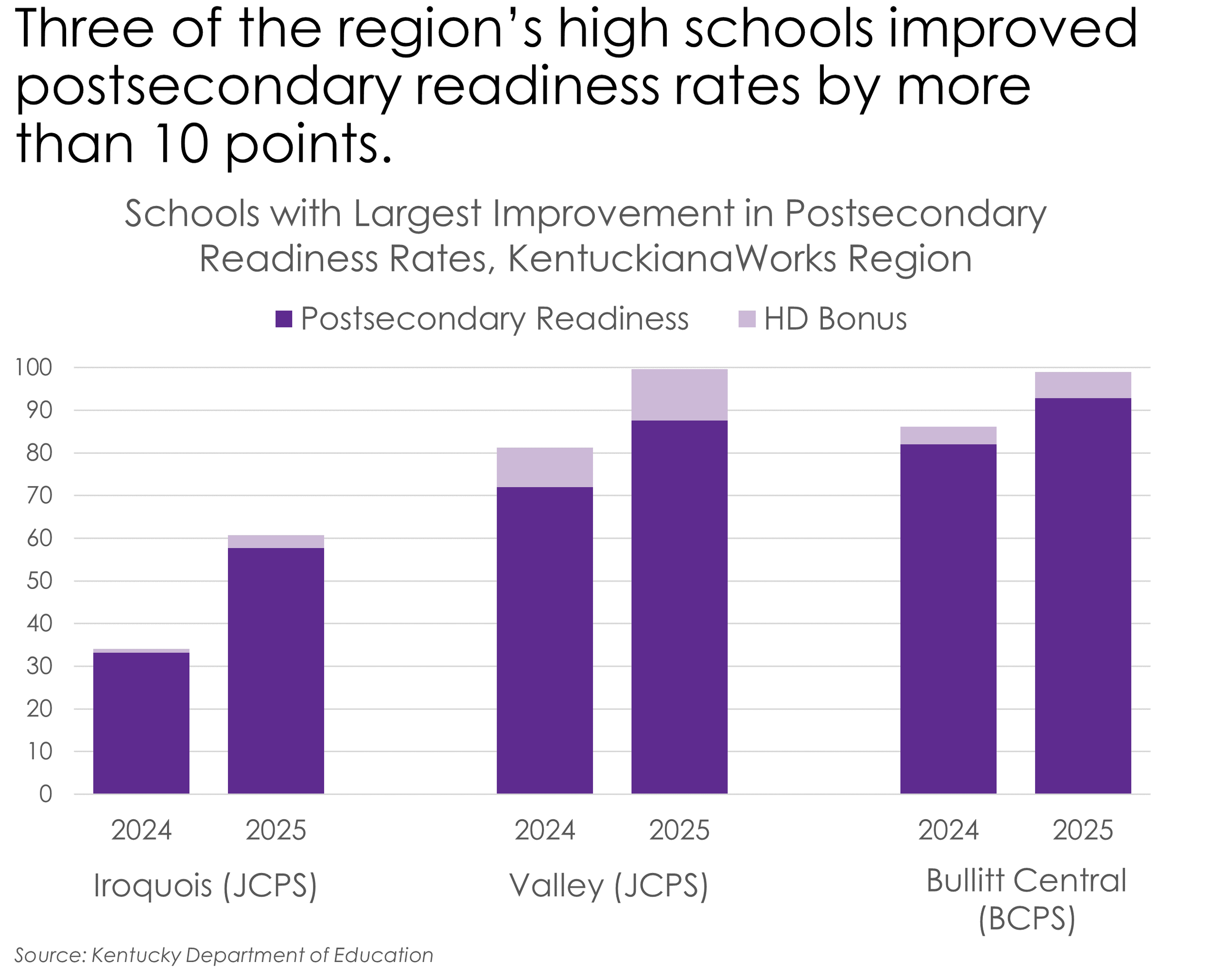
A few of the region’s high schools had gains of over ten points in postsecondary readiness between 2024 and 2025. Iroquois High School in Jefferson County went from a postsecondary readiness rate with bonus of 34.1% last year to 60.7% in 2025, a gain of 26.6 points- the largest in the region.
Spotlight on the Academies of Louisville
Postsecondary readiness rates at Academies of Louisville schools ranged from 95.1% at Atherton to 43.5% at The Academy @ Shawnee. Adding in the high demand bonus improves the postsecondary readiness rate at all fifteen Academy high schools, adding 1.2 points to Shawnee’s score, up to an additional 14.4 points at Jeffersontown. The range across schools grows to 104.8% at Atherton to 44.7% at Shawnee when including the bonus.
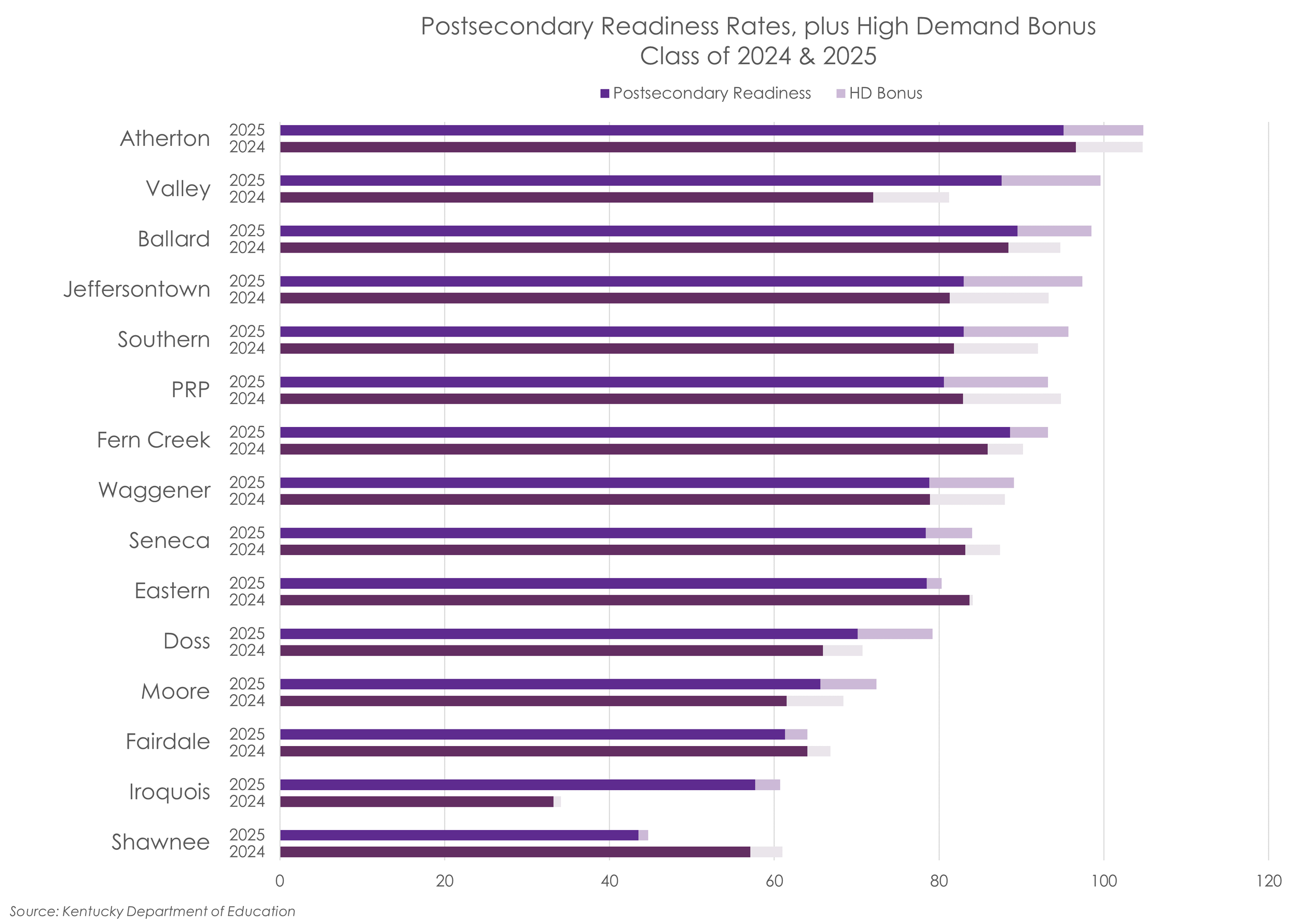
Ten of the fifteen Academy of Louisville schools realized an improvement in their postsecondary rates with bonus from last year. The largest gains were at Iroquois and Valley, followed by Doss, Jeffersontown, and Moore. Meanwhile, Shawnee, Eastern, Seneca, Fairdale, and Pleasure Ridge Park had lower postsecondary rates with bonus in 2025 as compared to 2024.
Conclusion
The Class of 2025's performance demonstrates both the progress being made in preparing students for life after high school and the work that remains ahead. The significant impact of high-demand industry certifications underscores the value of career and technical education (CTE) pathways in improving postsecondary readiness. At the same time, the variation in readiness rates among individual schools, from over 99% to under 50%, points to persistent equity gaps.
As we look to the Class of 2026 and beyond, KentuckianaWorks remains committed to supporting efforts that expand access to career exploration, work-based learning, industry certifications, and other pathways that prepare students for meaningful careers. Learn more about our efforts.
SummerWorks – a summer youth employment program for Jefferson County residents age 16-21
After the Tassel – career services for graduating seniors without a postsecondary plan
Academies of Louisville Alliance – coordinating business partnerships at Academies of Louisville high schools
KentuckianaWorks College Access Center – helping low-income and first generation students navigate the college admissions process
Explore Careers – Learn about in-demand quality careers in the region
Interested in exploring more about postsecondary readiness rates or other measures of school accountability? Check out the Kentucky Department of Education’s School Report Card. After selecting a school or district, use the left-side menu to select School Accountability -> Postsecondary Readiness.