
October is Manufacturing Month
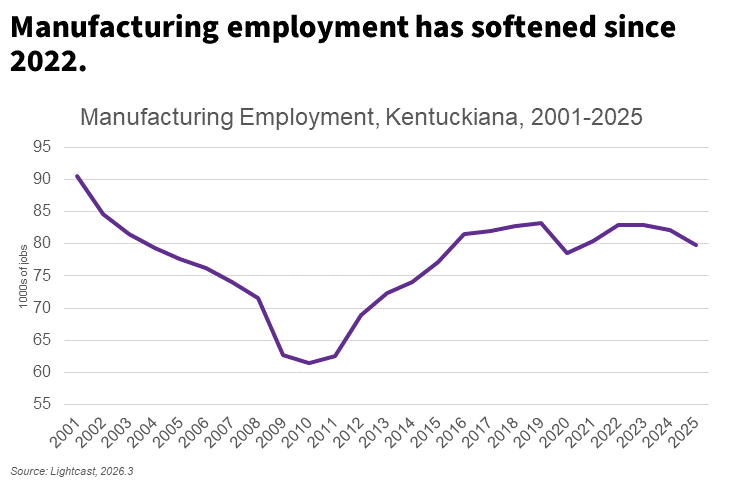
October is Manufacturing Month and there’s no better time to spotlight this critical industry in the Kentuckiana regional economy. Manufacturing is the region’s second largest industry, employing nearly 80,000 workers in 2025. It makes up 11% of local jobs, a concentration 1.5 times greater than in the US as a whole.
Employment in the manufacturing sector grew steadily in the wake of the Great Recession, growing by more than 19,000 jobs between 2011 and 2016, a gain of 30%. Employment levels dipped during the COVID recession, but recovered again before moderately declining. Between 2022 and 2025, manufacturing shed more than 3,000 jobs, a loss of 4%.
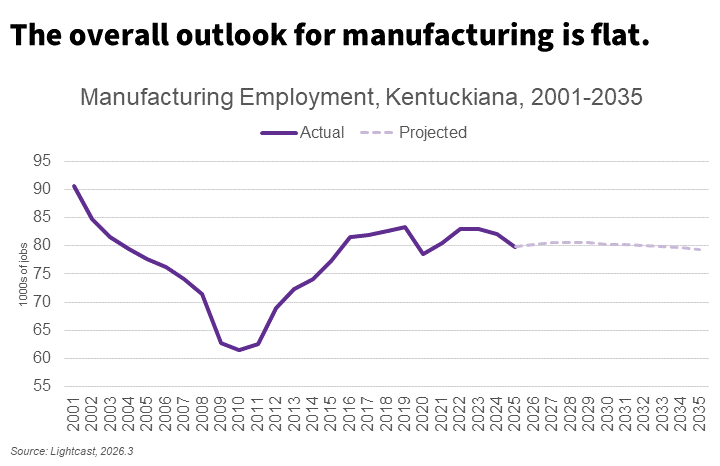
Employment projections over the next decade predict a continued pattern of essentially flat employment levels with a slight decline, losing around 500 jobs in the next 10 years. This loss of less than 1% is a drag on the overall projected job growth rate of 2%.
Data from the Occupational Outlook suggest not all Advanced Manufacturing jobs are projected to decline. Indeed, there is projected to be growing demand for a variety of manufacturing careers. The largest projected decline is for the entry-level team assembler role, falling from 20,000 jobs in 2025 to 19,000 jobs by 2035, a loss of about 1,000 jobs. At the same time, there is expected growth in occupations including industrial machinery mechanics, industrial and mechanical engineers, first-line supervisors, and welders.
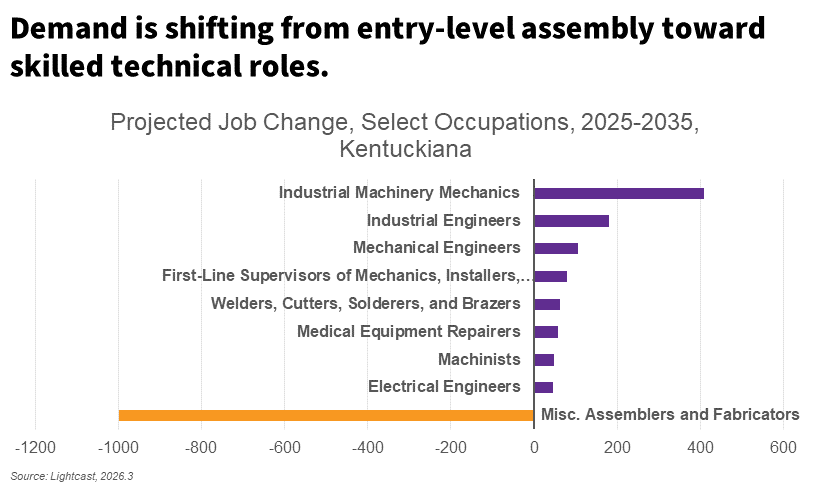
The changing dynamics in manufacturing careers suggest that technology is playing a role. Tasks that are repetitive and programmable are well-suited for advanced robotics, which then require workers who have the skills to design, operate, and repair the machines. This type of skill-biased technological change replaces some entry-level work with technology while creating demand for work in roles that typically require higher levels of education and training.
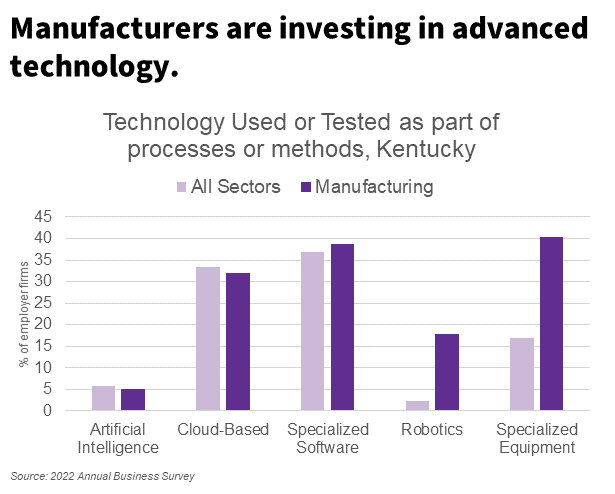
Census Bureau data show Kentucky manufacturing companies are investing in advanced technologies, with a higher share of manufacturers using or testing robotics and specialized equipment as compared to all industries.
The next generation of manufacturing workers is being trained by career and technical education (CTE) pathways in local high schools. Last school year more than 700 high school seniors across the Kentuckiana region were enrolled in manufacturing CTE pathways like automation engineering, welding, mechanical engineering, electrical engineering, and industrial automation and robotics, among others.
As manufacturers invest in new technology, the sector will need workers who can design, operate, and maintain it. Employers can help build that talent pipeline by getting involved early. Initiatives like the Academies of Louisville Alliance connect employers with students in career pathways, and SummerWorks offers a way to give young people their first hands-on work experience. This Manufacturing Month, consider how your company can help shape the region's next generation of skilled workers.