
The living wage in Kentuckiana
How much does a worker need to earn to meet their basic needs?
The short answer is - it depends. There is not a single wage level that provides economic self-sufficiency to all, because people have different circumstances. Factors like where a person lives and the size of their household impacts how much they need to earn.
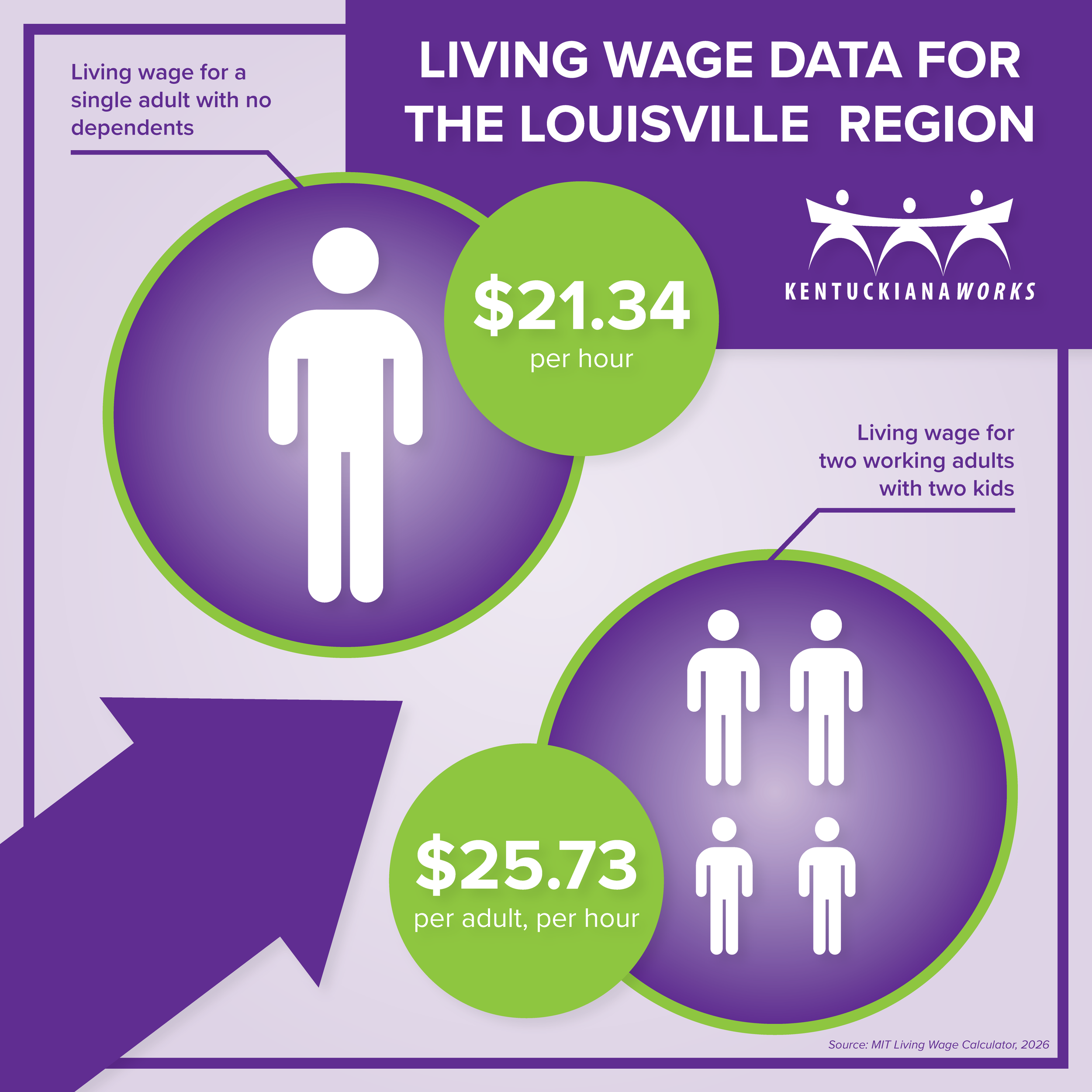
The Living Wage Calculator, developed by economists at MIT, crunches the data on modern-day expenses to estimate how much workers need to earn to meet their basic needs in the community in which they live and their household size. The latest version of the data was recently released, reporting that workers across the Louisville region need to earn at least $21 per hour to cover the costs of their basic needs.
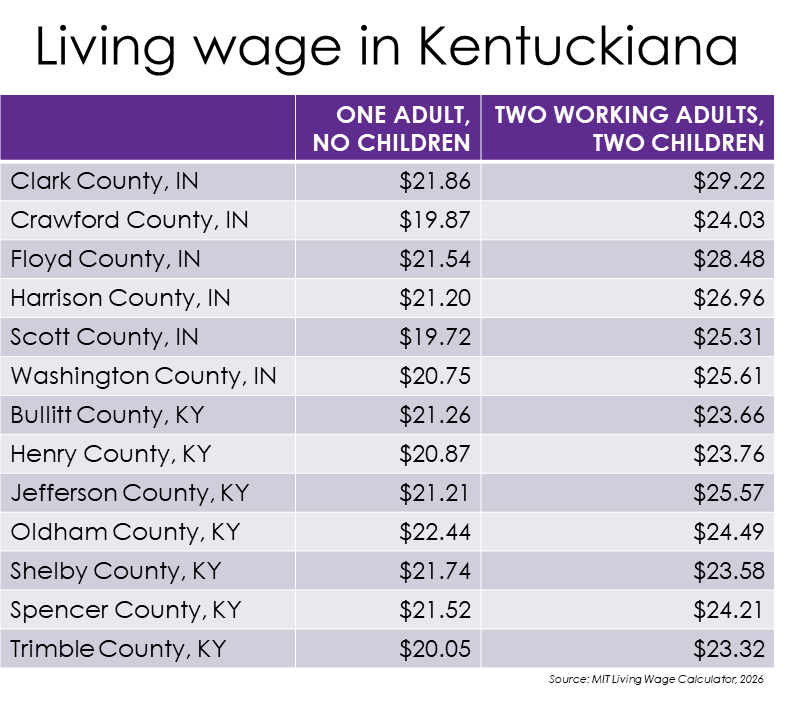
Even within the counties of the Kentuckiana region, there is some variation in the amount one needs to earn to meet their basic needs. Depending on the county in which they live, a single adult worker in the region needs to earn between $19.72 and $22.44 per hour, and work full-time, year-round to meet their basic needs. For a family of four with two working adults, each adult would need to earn between $23.32 and $29.22 per hour, and work full-time, year-round to cover the costs of child care and meet their family’s basic needs.
The living wage is the minimum threshold needed to maintain economic self-sufficiency without the use of public assistance programs and without facing severe housing or food insecurity. It does not account for expenses that many families would consider standard enjoyments, such as eating out at restaurants or taking a vacation. It also does not account for any savings or investment, including retirement savings or emergency expenses. It covers just eight basic needs - food, childcare (when applicable), healthcare, housing, transportation, civic engagement, broadband, and other necessities, with an additional cost associated with income and payroll taxes. It assumes a person works a full-time, year-round job, 2,080 hours per year.
According to Lightcast data, 62% of the region’s jobs are in occupations that typically provide a living wage for a single adult with no dependents, nearly 436,000 jobs. This leaves 2-in-5 local jobs with earnings that do not typically cover the basic needs of an individual. Furthermore, only about 290,000 local jobs typically provide a family supporting wage, just 41% of the region’s jobs.
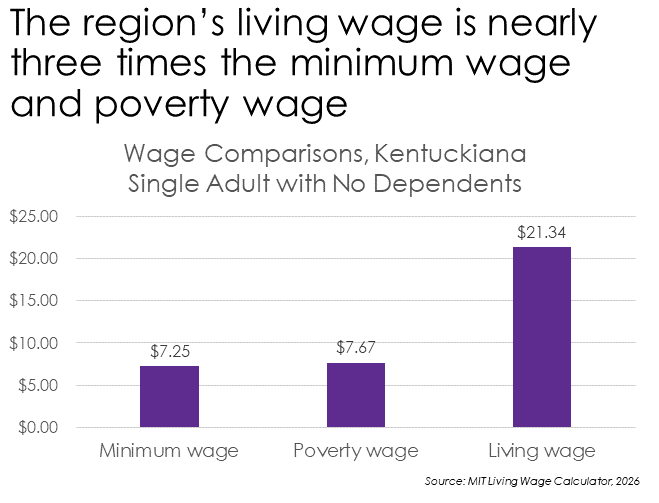
Other standards are often used to measure whether or not a person or household earns enough for a suitable standard of living. The minimum wage was last updated in 2009, up to $7.25 per hour. After adjusting for inflation, the minimum wage is equivalent to $4.71 per hour in today’s economy, 35% less than it was in 2009. Poverty guidelines rely on an outdated methodology, simply tripling a low-cost food budget. It does not incorporate any data on the current costs of housing, childcare, or healthcare. These outdated standards are much lower than the living wage.
KentuckianaWorks is supported by the Workforce Innovation and Opportunity Act (WIOA). A central goal of WIOA is for individuals to reach economic self-sufficiency, whereby they can earn enough to provide for themselves and their families without the use of public assistance programs. Helping workers earn a living wage is a critical part of our mission.
Explore the living wage in your community for various household sizes here.