
Spotlight on the finance and insurance industry
The finance and insurance sector plays an important role in the Louisville region's economy.
On average, the local finance and insurance industry employed more than 36,000 workers in 2025, accounting for 6% of the region's private sector employment. This level of employment is 1.26 times higher than would be expected for an economy the size of the Kentuckiana region, signifying its relative importance.
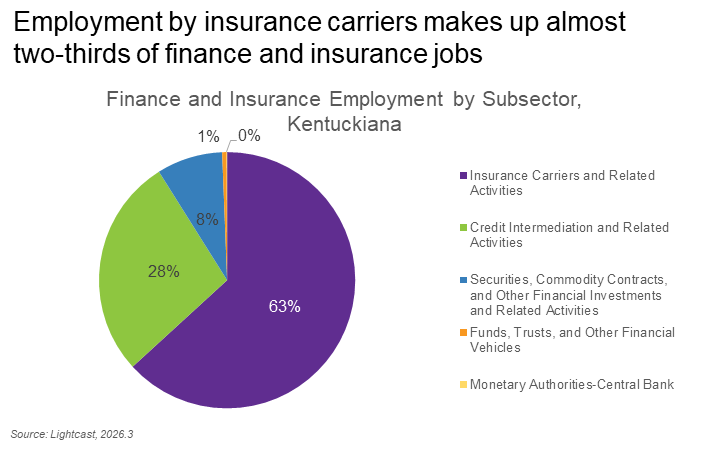
The finance and insurance sector is made up of five main types of businesses: insurance carriers and agents; banks, credit unions, and lenders (credit intermediation); investment firms and securities brokers; funds, trusts, and other financial vehicles like pension and mutual funds; and monetary authorities like the Federal Reserve.
Employment by insurance carriers makes up almost two-thirds of the region’s finance and insurance sector employment, and another quarter of employment is in banking.
Some of the most common occupations in the finance and insurance industry include insurance sales agents, claims adjusters, and loan officers. Many of these occupations have a median wage that is higher than the region's median wage across all occupations. One in ten employees in the finance and insurance sector are customer service representative roles, which does not pay the region’s median wage.
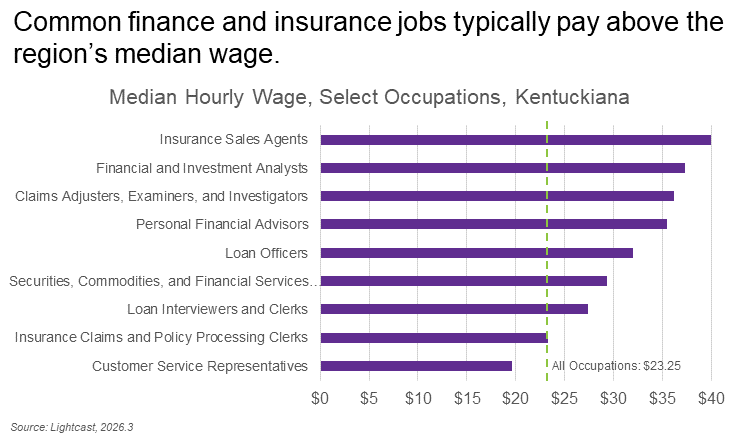
Unlike some other sectors, finance and insurance is one of the region's strongest pathways for college-educated workers. 52% of workers in the sector hold a bachelor's degree or higher, compared to 39% of employees regionwide, making it a key destination for local college graduates, and a sector where educational attainment tends to translate directly into higher pay.
Recent trends
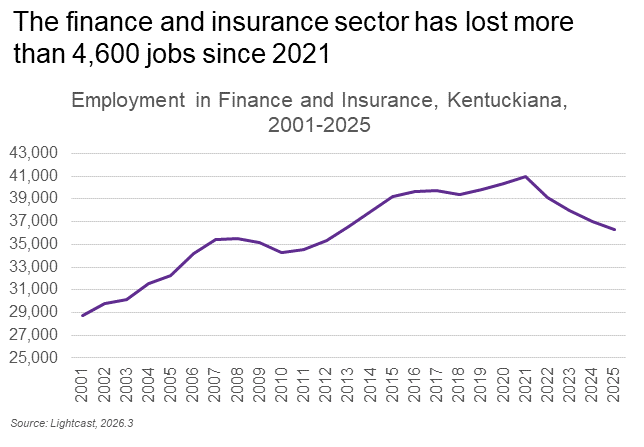
Since 2021, employment in the finance and insurance sector has declined by 11%, dragging down the region's overall private sector growth. In the last four years, the sector has lost more than 4,600 jobs.
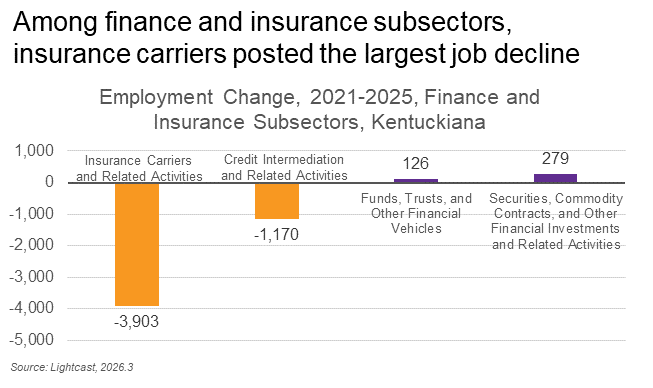
Of the five subsectors that make up the sector, employment declines have been the greatest among insurance carriers, which realized a 15% decline in employment levels since 2021, a loss of more than 3,900 jobs. Employment by credit intermediation companies also fell by more than 1,100 jobs. Meanwhile, an increase in employment by securities and investment firms and funds, trusts, and other financial vehicles firms was not nearly enough to offset the decline in other subsectors.
Looking ahead
Regional projections point to 5% employment decline in the finance and insurance sector over the next five years, losing an estimated 1,600 jobs. Job loss at insurance carriers is projected to account for nearly all of the estimated decline.
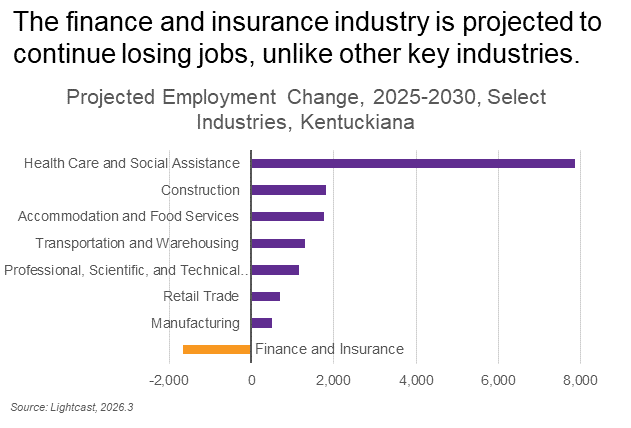
The finance and insurance sector's employment loss over the last five years and the further declines projected through the next five years stand out against the region's overall growth. A smaller presence among local insurance carriers, alongside the broader adoption of AI in functions like claims processing and customer service are likely affecting regional employment levels. Even so, the sector remains a key pathway for the region's college-educated workforce, and its wages continue to outperform the regional median. As Kentuckiana navigates this shift, the priority for the workforce system will be helping affected workers, especially those without a four-year degree, connect to opportunity in the region's growing industries.